Core Health
| Purpose | Standalone, always-on RabbitMQ + Redis monitor. Polls RabbitMQ's Management HTTP API and Redis's INFO/MEMORY STATS on its own connections and publishes curated MQTT/Home Assistant telemetry for both, replacing per-component RabbitMQ queue-depth self-polling |
| Run frequency | Always-on, three independent poll loops (RabbitMQ, Redis, and a once-daily container-registry check for the per-component "update available" entities) |
| Reads/writes | RabbitMQ Management API (read-only), Redis (INFO/MEMORY STATS plus plain key reads, both via the same default-user credential every other component uses), the container registry's public tags API (read-only, anonymous) — no direct RabbitMQ AMQP connection, no S3 |
How it works
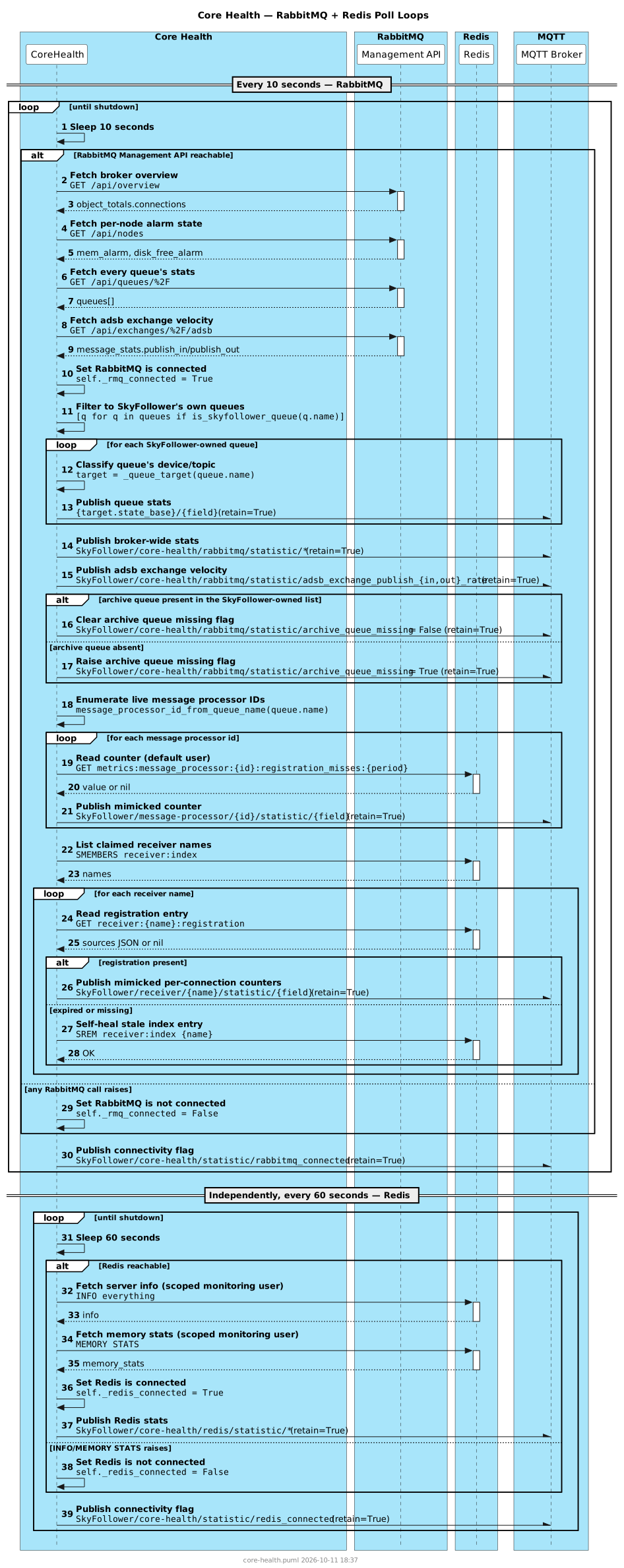
Two independent background loops, neither blocking the other:
- RabbitMQ, every 10s:
GET /api/overview(broker-wide connection count),GET /api/nodes(per-node memory/disk alarm flags —/api/overviewitself doesn't carry these despite being the endpoint originally named for this data point during design; polling/api/nodestoo is what actually answers it),GET /api/queues/%2F(every queue in one call), andGET /api/exchanges/%2F/skyfollower-adsb(theskyfollower-adsbexchange's own aggregate publish velocity —shared/rabbitmq_topology.py'sADSB_EXCHANGEconstant, no discovery needed). The queue list is filtered to SkyFollower's own queues viashared/rabbitmq_topology.py'sSKYFOLLOWER_RABBITMQ_RESOURCE_PATTERN— the exact same regexscripts/install.sh'sprovision_rabbitmq_users()uses to scope the application user's permissions, so the two definitions of "what SkyFollower owns" can't drift apart (bash can't import a Python constant, so the two copies are kept identical by hand — see the comments at each site). - Redis, every 60s:
INFO everything+MEMORY STATS, via the same default-user credential every other component authenticates with (see Credentials for why this isn't a separate scoped ACL user). No keyspaceSCAN/--bigkeysever — deliberately out of scope for this recurring loop (real cost against a large keyspace for a shape that doesn't change fast); the two commands above cover every field this component publishes.
Every entity core-health publishes for a queue or for Redis uses its own availability topic (SkyFollower/core-health/status), not the topic the device otherwise belongs to — a message processor being offline doesn't mean its queue's RabbitMQ-observed stats are unavailable (the broker still reports them), and vice versa. Queue/broker/Redis entities also carry expire_after (three poll intervals), so a poll failure that leaves a retained MQTT value in place doesn't read as still-fresh in Home Assistant indefinitely.
Where entities land
A Home Assistant device is just whatever entities share one device.identifier — core-health doesn't need to import or call into any other component's code, only know its device-identifier convention:
| Queue | Device | Identifier |
|---|---|---|
skyfollower-message-processor-{id} | That processor's own existing device | SkyFollower_message_processor_{id} (matches message-processor/main.py) |
skyfollower-archive | The archive processor's own existing device | SkyFollower_archive (matches archive-processor/main.py) |
skyfollower-adsb-unroutable, anything else SkyFollower-owned with no natural owner | New SkyFollower Core device | SkyFollower_Core |
Broker-wide RabbitMQ stats and all of Redis also land on the SkyFollower Core device. Per-queue entity unique_id/object_ids are suffixed _queue_{field} (e.g. SkyFollower_message_processor_{id}_queue_consumers) so they can never collide with the owning component's own entities on the same device (e.g. SkyFollower_message_processor_{id}_processing_time_hwm_ms).
Archive queue missing detection
Not every deployment installs archive-processor, so the skyfollower-archive queue being absent from the polled /api/queues/%2F list is a normal, valid state — not an error. But it's also indistinguishable, from an operator's perspective, from "core-health hasn't polled yet" unless something says so explicitly. Every RabbitMQ poll checks the (already-filtered) SkyFollower-owned queue list for skyfollower-archive's presence and publishes archive_queue_missing (rabbitmq_connections_total's sibling on the SkyFollower Core device) accordingly — True when it's expected but not found, False once it exists. This is scoped specifically to skyfollower-archive, the one queue every deployment eventually has; it deliberately does not attempt to distinguish "archive-processor never installed" from "installed, then the queue got deleted/misconfigured" — both look identical via the Management API, and the retained flag clears itself automatically the next time skyfollower-archive shows up in the poll either way.
Counter mimicry (message-processor and the receiver)
core-health also reads and publishes, on message-processor's and the receiver's behalf, a handful of their own Redis-backed application counters — using those components' exact existing topic paths, unique_id/object_id, and device blocks, so nothing on the wire distinguishes core-health publishing these from the owning component publishing them itself:
- message-processor:
registration_misses_{hour,today,lifetime},operator_misses_{today,lifetime},total_messages_processed_{hour,today,lifetime}— enumerated for free from the sameskyfollower-message-processor-{id}queue list already polled above, no separate discovery mechanism. - receiver:
messages_{host}_{port}_total_{hour,today}per source connection — discovered via one cheapSMEMBERSper RabbitMQ poll cycle against a small Redis index set of currently-claimed receiver names (never a keyspace scan), then oneGETper receiver for its registration entry (its source list). core-health is the sole publisher of these two (value and HA discovery); the receiver only feeds the Redis counters and never publishes those topics itself, so with no Redis configured they don't exist at all. The siblingmessages_{host}_{port}_total_lifetimesensor is not core-health's — the receiver publishes that one directly from its own in-memory counter (it resets on a receiver restart by design), and it is never written to Redis.
A missing period key means the count is genuinely zero, not unavailable — mirroring message-processor's own _redis_counter() precedent. This is distinct from core-health's own Redis connectivity failing outright, which is a real "skip this tick, let the entity age out" case (see _redis_counter_or_none() in main.py).
Update-available entities
core-health also publishes one Home Assistant update entity per SkyFollower component — its running image version versus the newest release published to the container registry — nested under that component's own existing Home Assistant device. It is an availability indicator only: the discovery config carries no command_topic, no payload_install, and no INSTALL supported feature, so Home Assistant shows that a newer version exists but offers no in-place upgrade button. Applying it stays a manual docker compose pull.
Which components are running, and what image to check, is learned entirely from self-registration — never inferred or pattern-matched. Every MQTT-enabled component publishes one retained SkyFollower/register/{id} message (shared/mqtt_register.py's publish_register(), called right alongside its own Home Assistant discovery publish) carrying its GHCR image name and its discovery device block verbatim. The image name is baked into the image at build time exactly the way VERSION/GIT_COMMIT already are: every Dockerfile declares ARG IMAGE=unknown / ENV COMPONENT_IMAGE=$IMAGE, and build-container-images.yaml passes an IMAGE build-arg of skyfollower- followed by that workflow's own matrix.name value — the same bare name its own discover-images job already computed as the single source of truth for what each component's published image is called, so there is no second, hand-maintained mapping of component identity to image name anywhere in this component's own code to drift out of sync with that workflow. core-health subscribes to SkyFollower/register/+ and reads image and device straight out of each payload. A component that clears its retained registration drops out of the registry and its update entity is cleared with it; an image that never registered itself is ignored — there is nothing running to compare against.
The registry poll is deliberately slow — once a day (shared/timing.py's GHCR_VERSION_CHECK_INTERVAL_SECONDS), plus one pass GHCR_VERSION_CHECK_STARTUP_DELAY_SECONDS after startup so the entities aren't blank until the following day. Published release tags only move on a release, and a single pass fetches an anonymous bearer token plus a tags list for every distinct image. The token is memoised inside shared/version_check.py and reused across the whole pass; tag ordering is a YYYY.MM.BB integer-tuple comparison ("2026.9.9" sorts before "2026.9.10", which a string compare gets wrong) — see shared/version_check.py. Every lookup failure — a network error, a rate-limit answer, an image with no release tags yet — is turned into "keep the last-known latest version" rather than blanking the entity, matching core-health's best-effort telemetry everywhere else.
State is a single retained JSON blob per component ({"installed_version": ..., "latest_version": ..., "release_url": ...}, release_url being the GitHub release page for the latest version, omitted until the first successful poll) that Home Assistant parses natively, published at SkyFollower/register/{id}/update — right alongside the registration that drives it — re-published on change, on every core-health MQTT (re)connect, and on each daily poll. The update entity's own availability is core-health's, not the owning component's (the registration payload carries no availability topic of its own), the same choice already made for the message-processor/receiver counter mimicry above. management-ui and map are covered the same as everything else now that they publish a minimal Home Assistant presence of their own (shared/mqtt_presence.py, which self-registers on their behalf in the same call).
Redis keys
message-processor's counter-writing side (operator_misses, total_messages_processed, and the reset-mechanism fix for registration_misses) has since landed, and this component's reading side was reconciled to it: metrics_registration_misses_key()/ metrics_operator_misses_key()/metrics_total_messages_processed_key() are all real shared/redis_keys.py builders now, imported directly rather than shimmed locally. message-processor is write-only for these three counters (accumulates in memory, flushes to Redis on its own telemetry cadence — see message-processor/README.md) — this component remains the only one that ever publishes them over MQTT/Home Assistant.
The receiver's identity/registration mechanism has landed too, and this component's reading side is reconciled to it in the same way: receiver_registry_index_key()/receiver_registration_key()/ receiver_message_count_key() are all real shared/redis_keys.py builders now, imported directly rather than shimmed locally. receiver is write-only for these (accumulates in memory, flushes to Redis on its own telemetry cadence — see receiver/README.md) — this component remains the only one that ever publishes them over MQTT/Home Assistant. No provisional local key shims remain in main.py.
Configuration
Reads its configuration from environment variables via shared/config.py's load_config("rabbitmq_management", "redis", "mqtt"), interpolated by Compose from this host's .env (written by scripts/install.sh).
| Variable | Required | Default | Description |
|---|---|---|---|
RABBITMQ_HOST | ✅ | — | Same broker every other component connects to |
RABBITMQ_MANAGEMENT_PORT | ❌ | 15672 | RabbitMQ's Management HTTP API port, not the AMQP port |
RABBITMQ_MONITORING_USERNAME | ✅ | — | RabbitMQ's built-in monitoring-tagged user (see Credentials) |
RABBITMQ_MONITORING_PASSWORD | ✅ | — | |
REDIS_HOST | ✅ | — | Same Redis every other component connects to |
REDIS_PORT | ❌ | 6379 | |
REDIS_PASSWORD | ✅ | — | The same default-user credential every other component uses — for both INFO/MEMORY introspection and plain key reads (application counters); see Credentials for why this isn't a separate scoped user |
MQTT_HOST | ❌ | — | Leave unset to disable MQTT entirely (core-health still polls, but publishes nothing) |
MQTT_PORT | ❌ | 1883 | |
MQTT_USERNAME | ❌ | — | Optional MQTT auth; leave unset for an anonymous broker |
MQTT_PASSWORD | ❌ | — | |
LOG_LEVEL | ❌ | info | "debug" for verbose output |
Credentials
- RabbitMQ: a new user tagged
monitoring— RabbitMQ's built-in tag for broker-wide, read-only Management API visibility, provisioned byscripts/install.shonce therabbitmqcontainer reports healthy (seeprovision_rabbitmq_users()). No per-resource permission is granted (or needed): themonitoringtag alone is what grants visibility, so this user'sconfigure/write/readpermissions are all set to match nothing. - Redis: no new credential — core-health authenticates as the same "default" user via
REDIS_PASSWORDevery other component already uses, for bothINFO/MEMORYand plain key reads. A separate, scoped (INFO/MEMORY-only) ACL user was designed and considered — it would have been the first Redis ACL user in this repo — but dropped: combining a new ACL user with theredisservice's existing--requirepassmechanism was confirmed live to silently disable password authentication on thedefaultuser entirely (not a startup error — Redis accepts an unauthenticated connection with noAUTHneeded at all), unless the ACL file is pre-seeded with the default user's own credentials before Redis's very first boot. That bootstrapping complexity and risk wasn't worth it for a restriction this component's own code already honors by simply never calling a write command — the same trust model every other component (message-processor, receiver, archive-processor) already operates under today.
MQTT
Published continuously (all retained) under SkyFollower/core-health/..., plus mimicked topics under the owning component's own root for the counter passthrough fields described above:
| Topic | Published from |
|---|---|
SkyFollower/core-health/status | ONLINE/OFFLINE, this component's own availability (LWT) |
SkyFollower/core-health/statistic/{started_at,rabbitmq_connected,redis_connected} | General |
SkyFollower/core-health/statistic/{rules_version,areas_version} | Canonical rules/areas config version (last 8 chars of config:rules:version / config:areas:version from Redis) — compare against each processor's own rules_version/areas_version sensor. Skipped (retained value left alone) while the key is absent or Redis is unreadable |
SkyFollower/core-health/rabbitmq/statistic/{field} | Broker-wide RabbitMQ stats |
SkyFollower/core-health/redis/statistic/{field} | Redis stats |
SkyFollower/core-health/message-processor/{id}/statistic/{field} | A processor's queue stats |
SkyFollower/core-health/archive/statistic/{field} | The archive queue's stats |
SkyFollower/core-health/queue/{queue}/statistic/{field} | Any other SkyFollower-owned queue's stats (e.g. skyfollower-adsb-unroutable) |
SkyFollower/message-processor/{id}/statistic/{field} | Mimicked message-processor counters (exact existing topic) |
SkyFollower/receiver/{name}/statistic/{field} | Mimicked receiver counters (exact existing topic) |
SkyFollower/register/{id}/update | Per-component "update available" state blob ({installed_version, latest_version, release_url}), published by core-health — see Update-available entities |
homeassistant/update/{id}_update/config | Per-component update entity discovery config, published by core-health (empty retained payload clears it) |
SkyFollower/register/{id} | Self-registration — subscribed here, published by every other MQTT-enabled component itself, not core-health (shared/mqtt_register.py) |
Home Assistant autodiscovery configs are published on every MQTT (re)connect for the static broker-wide/Redis/general entities, and opportunistically the first time a given queue/counter/receiver/component is seen during this process's lifetime (dynamic entities aren't known in advance — a message processor, receiver, or whole component can appear or disappear while core-health keeps running).
Deployment
Deployed via docker-compose.core.yaml, always-on alongside rabbitmq/redis/ofelia (restart: unless-stopped, no profiles:). No depends_on — both clients simply retry on their own poll cadence until each backend is reachable, and this component keeps no state of its own (a pure poller/republisher), so it has no data volume, only the same tmpfs-mounted healthcheck heartbeat file every other long-running component uses.