Message Processor
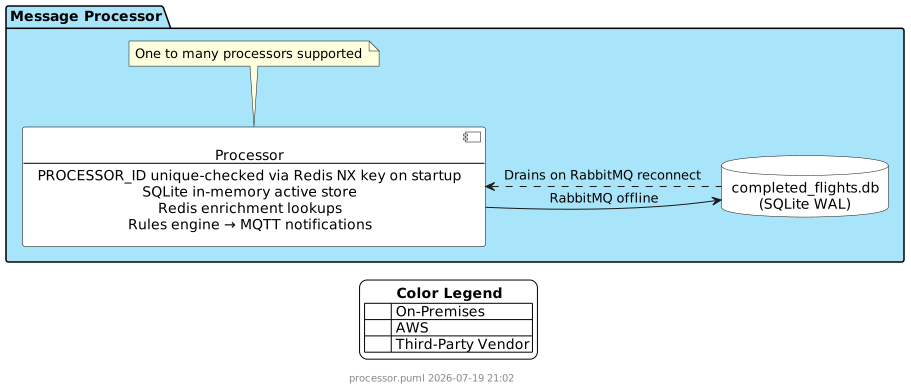
The message processor consumes raw ADS-B and UAT messages from a RabbitMQ queue, maintains per-aircraft flight state in a file-backed (WAL-mode) SQLite database so it survives a process restart, enriches each flight with registration and operator data from Redis, evaluates the configured rules engine, publishes MQTT notifications when rules match, and routes completed flights to the archive queue (or a local SQLite fallback when RabbitMQ is unavailable). One container equals one processor instance; scale horizontally by adding processor containers on separate hosts.
Configuration (settings.json)
| Field | Type | Default | Description |
|---|---|---|---|
rabbitmq.host | string | — | RabbitMQ hostname or IP |
rabbitmq.port | integer | 5672 | RabbitMQ AMQP port |
rabbitmq.username | string | — | RabbitMQ username |
rabbitmq.password | string | — | RabbitMQ password |
redis.host | string | — | Redis hostname or IP |
redis.port | integer | 6379 | Redis port |
mqtt.host | string | — | MQTT broker hostname (omit key to disable MQTT) |
mqtt.port | integer | 1883 | MQTT broker port |
mqtt.username | string | — | MQTT username. Optional — omit both username and password to connect anonymously. |
mqtt.password | string | — | MQTT password |
rule_notification_max_lag_seconds | integer | 30 | Maximum age (seconds, message received_at vs. wall-clock time) of a message whose rule match still gets published to MQTT. Older matches (replayed from a RabbitMQ backlog after a restart) still fire and are recorded in matched_rules, just not pushed to MQTT — prevents flooding MQTT with backlogged notifications the instant a processor reconnects. |
telemetry_interval_seconds | integer | 30 | How often (seconds) the processor publishes MQTT statistic messages and refreshes its Redis heartbeat key. |
latitude | float | — | Receiver location latitude (decimal degrees). Required for single-message CPR airborne position decoding. Omit if position decoding is not needed. |
longitude | float | — | Receiver location longitude (decimal degrees). |
data_dir | string | "/app/data" | Host-mounted directory where active_flights.db (the durable active flight store) and completed_flights.db (the RabbitMQ offline fallback) are written. |
log_level | string | "info" | Log verbosity. Set to "debug" for verbose output. |
PROCESSOR_ID Environment Variable
PROCESSOR_ID is a required integer environment variable set in the Docker Compose service definition. It must match one of the queue names declared by the receiver (adsb-0, adsb-1, …). The processor consumes from adsb-{PROCESSOR_ID}.
On startup the processor attempts to claim a Redis key processor:{PROCESSOR_ID}:heartbeat using SET NX. If the key already exists (i.e., another instance with the same ID is running), the process exits immediately to prevent duplicate-ID conflicts.
Example:
environment:
  PROCESSOR_ID: "0"
Decoding
Raw Mode-S/ADS-B frames are decoded via pyModeS 3.x's single unified decode() call, which returns every decodable field for a message in one dict. The processor extracts fields purely by presence — if a field is in the result, it's used; there's no downlink-format or typecode dispatch, and no downlink-format allowlist. Message types that don't populate any field the processor cares about (e.g. ACAS RA broadcasts) simply produce nothing and are dropped, with nothing to explicitly filter.
Any message pyModeS flags as CRC-invalid is rejected outright — but this only provides real protection for DF17/18 (extended squitter), where crc_valid reflects an actual CRC-remainder-equals-zero check. For DF0/4/5/11/16/20/21 (including squawk, DF5/21), pyModeS hardcodes crc_valid=True unconditionally, since their CRC field encodes the ICAO address itself rather than providing an independent integrity check — there's no single-message corruption signal available for those message types at all. A squawk value is trusted once decoded; there's nothing further to verify it against outside of multi-message/pipe-mode decoding, which this processor doesn't use.
wake_turbulence_category is sourced directly from pyModeS's own computed wake_vortex field, which is aware of which identification sub-type (typecode) a category code came from — TC=4 aircraft categories, TC=3 gliders/UAVs, and TC=2 surface vehicles are all encoded on the same numeric scale but mean different things, and pyModeS's mapping accounts for that.
Redis Key Dependencies
Keys read
| Key pattern | Purpose |
|---|---|
EVALSHA → shared/lua/merge_aircraft.lua | Aircraft registration and type enrichment (read once per new flight). Not a direct key read: the processor calls this script (SCRIPT LOADed once at startup) with icao_hex as its sole argument and has no visibility into what it reads. The script itself performs the underlying JSON.GETs against aircraft:mictronics:{icao_hex} and aircraft:registry:{icao_hex} server-side and returns the deep-merged result (registry winning on any field overlap) in a single round-trip. |
operator:{DESIGNATOR} | Airline operator enrichment (read once per flight when ident is first seen) |
flight:{IDENT} | Origin/destination enrichment (read once per flight when ident is first seen) |
config:rules:version | SHA-256 hash polled every 5 s; triggers rule reload when changed |
config:rules | JSON rules array; loaded when version changes |
config:areas:version | SHA-256 hash polled every 5 s; triggers area reload when changed |
config:areas | GeoJSON FeatureCollection; loaded when version changes |
config:flight_ttl_seconds | Plain scalar, read once at startup and cached (not hot-reloaded — restart to pick up a changed value); defaults to 300 if unset. Shared with the archive processor, which uses the same value to detect flights split by a processor-count resize. |
Keys written
| Key pattern | Purpose |
|---|---|
processor:{ID}:heartbeat | Liveness key; claimed with NX on startup, TTL refreshed every telemetry_interval_seconds × 2 |
registration:{REGISTRATION} | Reverse-lookup index (registration → ICAO hex); written NX when aircraft enrichment is found and a registration exists |
metrics:processor:{ID}:registration_misses:{hour|today|lifetime} | Incremented each time an icao_hex: or operator: lookup returns no result. The _hour key has a 3600 s TTL; _today expires at the next UTC midnight. Both are set on first write via INCR + EXPIREAT/EXPIRE. _lifetime has no TTL. |
metrics:processor:{ID}:aircraft_type_misses:{hour|today|lifetime} | Incremented each time an aircraft type lookup returns no result. Same TTL scheme as above. |
MQTT Topics Published
All topics use the root SkyFollower.
| Topic | Payload | Retained |
|---|---|---|
SkyFollower/processor/{ID}/status | ONLINE or OFFLINE | Yes |
SkyFollower/processor/{ID}/statistics | JSON stats payload (see fields below) | Yes |
SkyFollower/rule/{IDENTIFIER} | JSON flight snapshot (no positions/velocities) with rule key | No |
Statistics payload fields:
| Field | Type | Description |
|---|---|---|
started_at | string | UTC ISO-8601 timestamp of process start |
messages_per_second | float | Rolling 30-second average message rate |
processing_time_hwm_ms | float | End-to-end processing time high-water mark since last publish; resets on publish |
rules_engine_hwm_ms | integer | Rules engine duration high-water mark since last publish; resets on publish |
rabbitmq_input_queue_depth | integer | Current input queue depth (-1 on error) |
local_archive_queue_depth | integer | Completed flights queued in completed_flights.db fallback |
registration_misses_hour | integer | Aircraft Redis cache misses this hour |
registration_misses_today | integer | Aircraft Redis cache misses today (UTC) |
aircraft_type_misses_hour | integer | Aircraft type lookup misses this hour |
aircraft_type_misses_today | integer | Aircraft type lookup misses today (UTC) |
active_flights | integer | Flights currently tracked in the active store |
All statistics are published as a single retained JSON payload every telemetry_interval_seconds. Home Assistant autodiscovery payloads are published to homeassistant/sensor/SkyFollower_processor_{ID}_{field}/config on MQTT connect, each using value_template to extract its field from the shared statistics topic.
Fault Tolerance
When RabbitMQ is unavailable at startup or during operation, completed flights are written to completed_flights.db (SQLite WAL mode) in data_dir. On the next successful RabbitMQ reconnect, the fallback queue is drained oldest-first before new messages are consumed. Redis and MQTT failures are handled gracefully and logged; enrichment lookups that fail leave the flight partially enriched rather than dropping it.
Active flight store durability & crash recovery
active_flights.db (SQLite, WAL mode, data_dir) holds every currently tracked flight and is committed to disk after every message. A process end — whether a deliberate stop (SIGTERM/SIGINT) or an ungraceful one (OOM-kill, docker kill, host crash) — is recovered identically on the next startup; there is no special "flush everything" shutdown path, since nothing needs force-archiving when the store already survives on its own.
On startup, the processor reopens active_flights.db and recovers whatever flights were still tracked. Recovery is driven by message timestamps, not by how long the container was down: an internal clock is floored at the most recent last_message among recovered flights (not wall-clock "now"), and only advances as RabbitMQ messages are actually consumed. This means a recovered flight is not archived just because real time passed while the container was stopped — if a continuation message for that aircraft is sitting in the RabbitMQ backlog, it resumes the same flight once the processor reconnects and drains the backlog. A genuine gap longer than flight_ttl_seconds — whether it happens live or is discovered while replaying a backlog — still correctly splits the flight into two records.
MQTT rule notifications for messages older than rule_notification_max_lag_seconds are suppressed during backlog replay (logged at debug) to avoid flooding MQTT the instant a processor reconnects after downtime; the rule still fires and is still recorded in matched_rules/the eventual archived flight.
Because active_flights.db only depends on PROCESSOR_ID (which determines the RabbitMQ queue consumed, adsb-{PROCESSOR_ID}) and not on container identity, moving the file to a replacement container with the same PROCESSOR_ID resumes tracking the same way a restart does. One caveat: the Redis heartbeat key (processor:{PROCESSOR_ID}:heartbeat, SET NX with a TTL of 2 × telemetry_interval_seconds) must expire — or be deleted manually — before a replacement container can claim the same ID.
Rules Engine
Rules and areas are loaded from Redis (config:rules / config:areas) and hot-reloaded every 5 seconds when the corresponding version hash keys change. The rules engine is implemented in processor/rules_engine.py.
Each rule must have a unique identifier, an enabled boolean, and a non-empty conditions array. All conditions within a rule are ANDed together. A rule fires at most once per flight per identifier (the identifier is added to flight.matched_rules on first match, and subsequent evaluations skip it).
Conditions are sorted by evaluation cost before each evaluation pass — cheap field comparisons run before expensive geographic checks. See Rules & Areas for the full condition type reference.